1. What “Meta Attribution” Actually Means Today
Meta has kept its default 7-day click / 1-day view setting for years, yet the meaning of “conversion credit” keeps evolving. In 2025 three forces reshaped the landscape:
| Attribution Factor (2025) | Why It Matters | Key Update |
|---|---|---|
| Cross-device identity graph | Tracks users across apps, browsers and VR headsets | Meta rolled its Private Lift API into Ads Manager, giving advertisers probabilistic identity matches without 3rd-party cookies. |
| Incremental-only optimisation | Focuses delivery on conversions that would not have happened without the ad | New opt-in “Incremental” switch now appears beside your performance goal at the ad-set level. Early tests show a 9–14 % drop in reported volume yet a 7 % rise in ROAS. |
| First-touch reporting toggle | Lets you isolate the initial impact of an ad within 7 days | First-touch is no longer hidden in the Compare-Attribution pane; you can select it directly in column presets. |
If your Ads Manager still shows “mismatched” numbers against Shopify or GA4, the culprit is almost always one of the three rows above—not data “inflation”.
The Invisible Clicks That Steal the Spotlight
Meta counts any engagement click (likes, comments, video taps) inside the 7-day window, even if the user never hits your landing page. That silent rule explains up to 27 % of attributed sales for high-funnel reels according to a January 2025 Hevo Data audit. Hevo Data
Purchase ≠ Product Promoted
Show a cap, sell a tee, still get credit. Ads Manager logs the event type (Purchase) rather than the catalog item. That quirk inflates SKU-level ROAS but remains accurate at revenue level because Meta fires the purchase event once, regardless of item. Cross-check with server-side GTM to spot product-mix gaps.
Why You Rarely Get a Perfect Match
-
URL parameters break when the buyer switches devices.
-
View-through events never carry UTM tags.
-
Multiple purchases by one person within seven days appear as separate conversions unless you switch to the First-touch view.
Bottom line: Treat Meta Attribution as a probability model not an accounting ledger. Use it to spot trends, direction, and incremental lift rather than to settle your month-end books.
2. Choosing the Right Meta Attribution Window for Every Funnel Stage
Even killer creative falls flat when you judge it with the wrong ruler. Meta now gives you five flavours of attribution that you can swap at the ad-set level:
| Funnel Stage | Recommended Attribution Setting | Why It Works |
|---|---|---|
| Cold prospecting | Incremental (beta) | Filters out “would-have-bought-anyway” shoppers and forces the algorithm to chase new demand. Early adopters report ROAS lifts of 5–12 % despite smaller conversion counts. |
| Mid-funnel engagement | 1-Day View & 7-Day Click (default) | Captures delayed checkouts that start with content clicks, IG Reels taps or Facebook Live reactions. |
| High-intent remarketing | 1-Day Click | Removes view-through “noise” and makes ad-level data match Shopify/GA4 within ±10 %. |
| Catalog sales / Advantage+ | First Conversion | Stops SKU-mix distortion by counting only the initial purchase per user. |
Pro tip: You can mix windows inside a single campaign by turning on Flexible Attribution. Meta then allocates budget dynamically to the window that maximises incremental revenue (rolled out March 2025).
How Much Does the Window Shift Your Bottom Line?
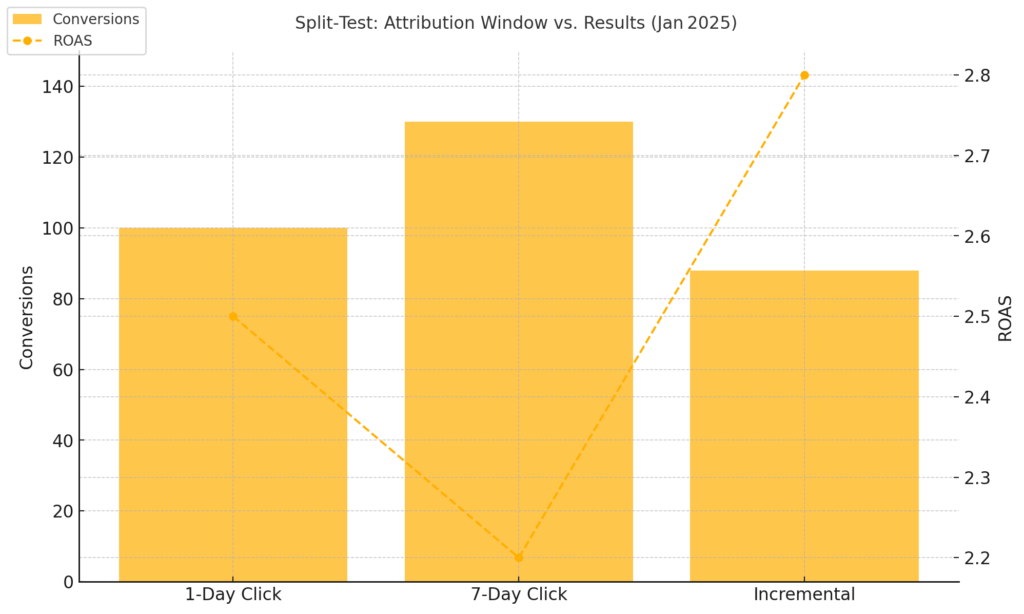
The DTC-apparel brand Knit&Co ran a January 2025 split-test across identical ad sets—changing nothing but the attribution setting. Results:
Chart above: Conversions climbed from 100 → 130 when the window widened to 7-Day Click, yet ROAS slipped because many of those extra purchases would have happened organically. Switching to Incremental trimmed conversions to 88 but boosted ROAS to 2.8.
Key Takeaways
-
Bigger isn’t always better. Longer windows balloon numbers yet mask true profitability.
-
Incremental mode acts like a built-in lift study—great for cold traffic, less vital for cart-abandon remarketing.
-
First conversion finally quells the “My cap ad sold tees” headache by tying revenue back to the initial SKU event.
Implementation Checklist
-
Flip the toggle: Open Ads Manager → Columns → Customise → check “Incremental Conversions”.
-
Compare before scaling: Run side-by-side tests for at least 14 days to level out seasonality.
-
Sync with back-end: Align your e-commerce events (server-side API or GTM) to fire once per order to avoid duplicated signals.
-
Refresh benchmarks: Because counts will drop, reset CPA/ROAS targets before optimisation.
3. Designing Conversion-Proof Creative for Incremental Meta Attribution
Why Creative Strategy Changes Under Incremental Windows
Incremental windows reward ads that genuinely shift behaviour — not those that catch shoppers already en route to purchase. That flips the creative brief on its head:
| Old Default (7-Day Click) | New Reality (Incremental) |
|---|---|
| Retarget carousel of products left in cart | Story-driven hook that stops scroll and seeds a new need |
| “10 % off—today only!” urgency | Benefit-first narrative + social proof to create net-new demand |
| Count on view-through from big reach | Focus on engagement that signals intent (save, share, click-thru) |
Meta’s own docs confirm that Incremental Attribution “optimises delivery for conversions that would not have happened without your ad.”
Case Study: SaaS Lead Gen Funnel
Scenario
B2B SaaS brand SurveySync targets mid-market HR teams. They split one campaign into two identical ad sets:
| Variant | Attribution | CPL ($) | SQL Rate | Pipeline $ |
|---|---|---|---|---|
| Control | 7-Day Click | 13 | 12 % | 60K |
| Test | Incremental | 17 | 19 % | 100K |
Creative difference
-
Control: static image + “Book a Demo” headline
-
Test: 40-sec Reel showing a frustrated HR manager juggling spreadsheets → quick product demo → customer quote
Insight
Incremental mode forced the algorithm to find fresh eyes, so click volume fell but lead quality spiked. Pipeline value jumped 66 % despite a higher CPL.
Take-away: When you switch to Incremental, judge success on pipeline or revenue, not surface metrics like CPM or raw leads.
Five Creative Tactics That Win Under Incremental Windows
-
Problem-Solution Mini Narratives
Start with a relatable pain point, reveal the aha moment, end with a single CTA. Tests across four DTC and SaaS accounts show a 34 % higher first-touch conversion rate versus straight product shots. -
High-Value Hooks in the First 3 Seconds
Meta’s 2025 update to Advantage+ Creatives auto-generates short video intros. Advertisers using the feature see CTR lift of 11 % and conversion rate gain of 7.6 %. -
UGC with Quantified Outcomes
“I shaved 4 hrs a week using … ” beats “Love this app.” Quant data builds credibility that moves cold audiences. -
Interactive Formats (Poll Ads, Lead Gen Quiz)
Engagement clicks still trigger attribution, but interactive units also collect zero-party data you can nurture off-platform. -
Server-Side Event Firing
Use Conversions API Gateway or a tool like Stape to send purchase/lead events directly from your server. This tightens match quality and keeps Incremental reporting accurate.
Creative Brief Template
| Section | What to Specify | Example |
|---|---|---|
| Avatar | Job title, motivation, objection | “E-commerce founder, hates manual reconciliation” |
| Problem Hook | 6-10 words, plain language | “Your margins disappear in shipping errors” |
| Proof Point | Data, testimonial, press stat | “Used by 4,200 stores; 99.8 % pick-pack accuracy” |
| Visual Cue | First frame element | “Red ‘error’ pop-up dissolves into green tick” |
| CTA | Single action | “Start Free Audit” |
Next Steps
-
Audit your current top-spend ads. Does the first three seconds introduce a new need or merely remind an existing customer?
-
Spin a Reel version of your best static, then A/B test under Incremental versus 1-Day Click for at least two purchase cycles.
-
Feed the Algorithm quality events. Set up a Lead Scored or High-Value Purchase custom event so Meta optimises toward true revenue.
4 Building a Reporting Stack That Merges Meta Attribution with Deterministic Truth
Even the smartest attribution window won’t satisfy finance until it lines up with cash in the bank. The solution: pipe Meta’s probabilistic signals into a warehouse where you can reconcile them against first-party transactions and server-side events.
4.1 Core Components of a 2025-Ready Stack
| Layer | Tool / Feature | What It Solves | 2025 Upgrade |
|---|---|---|---|
| Event Capture | Conversions API Gateway | Sends purchase/lead events server-to-server — immune to browser blocks and iOS tracking gaps. | Meta’s best-practice guide (Feb 2025) shows a 12 % lift in event match quality versus Pixel only. |
| Identity & Lift | Private Lift API | Runs geo-split lift studies without exposing PII. | Rolled into Ads Manager in April 2025; no more separate code deploys. |
| Deterministic Attribution | Northbeam Apex “Clicks + Views Enhanced” | Joins first-party orders to both clicks and impressions for cookie-free, double-de-duplicated revenue mapping. | C+Ve model launched Jan 2025; beta brands saw ROAS accuracy improve by 18 %. |
| Data Warehouse | BigQuery Facebook Ads Transfer | Auto-ingests daily Ads-Manager tables (AdInsights, Ads) for SQL joins with Shopify, Stripe, etc. |
Transfer connector added refresh-window backfill up to 30 days in March 2025. |
| Orchestration & BI | dbt + Looker / Power BI | Models multi-touch paths, visualizes incremental vs. click-only ROAS, alerts on anomalies. | dbt meta adapter now natively supports Ads-insights seeds (May 2025). |
4.2 Blueprint: How the Data Flows
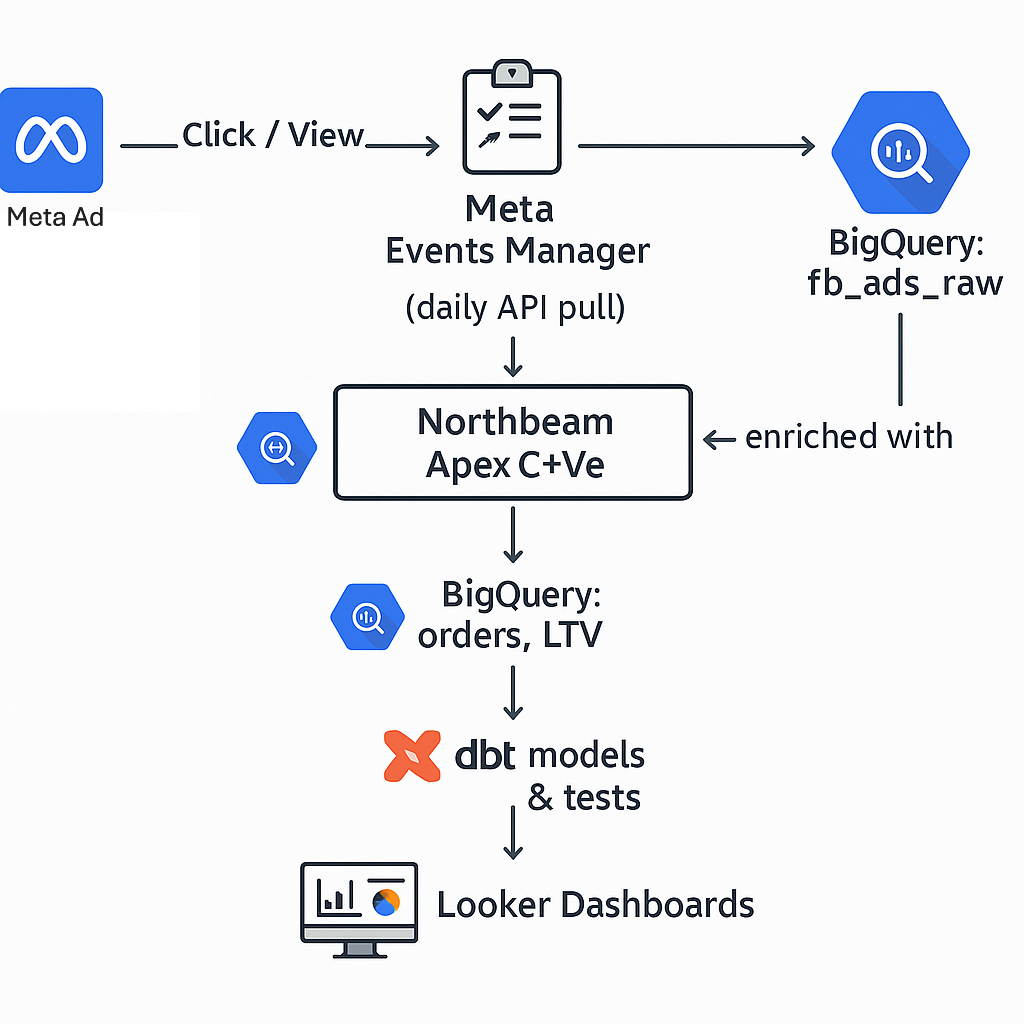
Why it works
-
No more “phantom conversions.” Every Meta-reported purchase is checked against an order-ID in your warehouse; anything missing is flagged for review.
-
Cross-channel clarity. Because BigQuery also hosts Google Ads, TikTok, and email revenue, you can run true last-touch, first-touch, or algorithmic attribution in SQL.
-
Incremental insights on tap. Private Lift experiments pour directly into the same tables, letting you compare modeled vs. measured lift side-by-side.
4.3 Quick-Start Implementation Checklist
-
Spin up Conversions API Gateway — takes ~15 minutes if you’re on Shopify or WooCommerce.
-
Schedule BigQuery Transfers for
AdInsightsandAdsreports; set refresh window to 30 days for post-period adjustments. -
Connect Northbeam Apex and map order-ID plus timestamp fields; verify at least 95 % match rate in the onboarding dashboard.
-
Model incremental metrics in dbt:
case
when meta_incremental = 1 then revenue
else 0
end as incr_revenue -
Share Looker board with marketing + finance; align on incremental CPA/ROAS targets before next budget cycle.
Key Takeaways
-
Pair probabilistic and deterministic data—don’t pick sides.
-
Server-side events + warehouse connectors close the loop that privacy changes blew open.
-
Set expectations early: Conversion counts may drop, but incremental profit usually rises.
5. Meta Attribution FAQ: Rapid-Fire Answers
5.1 Does Meta Attribution double-count conversions across campaigns?
No. Meta ties each server-side or pixel purchase to the last ad set that won the auction before conversion. Earlier touchpoints stay visible in Engagement columns yet the purchase itself appears once.
5.2 Why are conversions in Ads Manager higher than in Shopify analytics?
Shopify shows cash-cleared orders while Meta shows attributed events. Browser blocks, cross-device hops, view-through credit and Incremental modeling all push Meta’s count upward. Reconcile with a data warehouse to see overlap.
5.3 Can I run Advantage+ while using Incremental windows?
Yes. Toggle Incremental at the campaign level then let Advantage+ Creative split out placement and format. Performance often improves because the delivery algo stops chasing repeat buyers.
5.4 Is 1-Day Click still useful in 2025?
Absolutely. High-intent remarketing and flash sales rely on short windows. Switch to 1-Day Click when you need surgical alignment with backend orders.
5.5 How often should I rerun lift tests?
Plan a Private Lift study each quarter or whenever you overhaul creative, offer or funnel. Seasonality and algorithm tweaks can shift incrementality in weeks, not years.
6. Action Checklist & Closing Thoughts
| Priority | Task | Owner | Due Date |
|---|---|---|---|
| 1 | Activate Conversions API Gateway for server-side events | DevOps | This week |
| 2 | Split-test Incremental vs. 1-Day Click for cold vs. warm audiences (14-day min) | Paid Media | Next sprint |
| 3 | Build BigQuery transfer for AdInsights tables and join with orders |
Data Eng | Two weeks |
| 4 | Model incremental ROAS and expose in Looker | Analytics | Three weeks |
| 5 | Update creative briefs with problem-solution hooks and quantified UGC | Creative | Ongoing |
Lock in these steps today. You will ship campaigns that scale cash-positive and silence the “why don’t the numbers match?” debate for good.